The Kuiper Belt (rhymes with viper) is often called our Solar Systems 'final frontier.' The kuiper belt is a band of icy rocks that orbit the sun, about 55 AU away from the sun. The kuiper belt is the reason Pluto is no longer a planet. It is like the asteroid belt except 20 times as wide and 200 times as massive. There are more than 70 000 KBO's (kuiper belt objects) over 100 KM in diameter; Pluto being one of the larger ones. Scientist know very little about the kuiper belt but it is believed to be where comets originate from. | 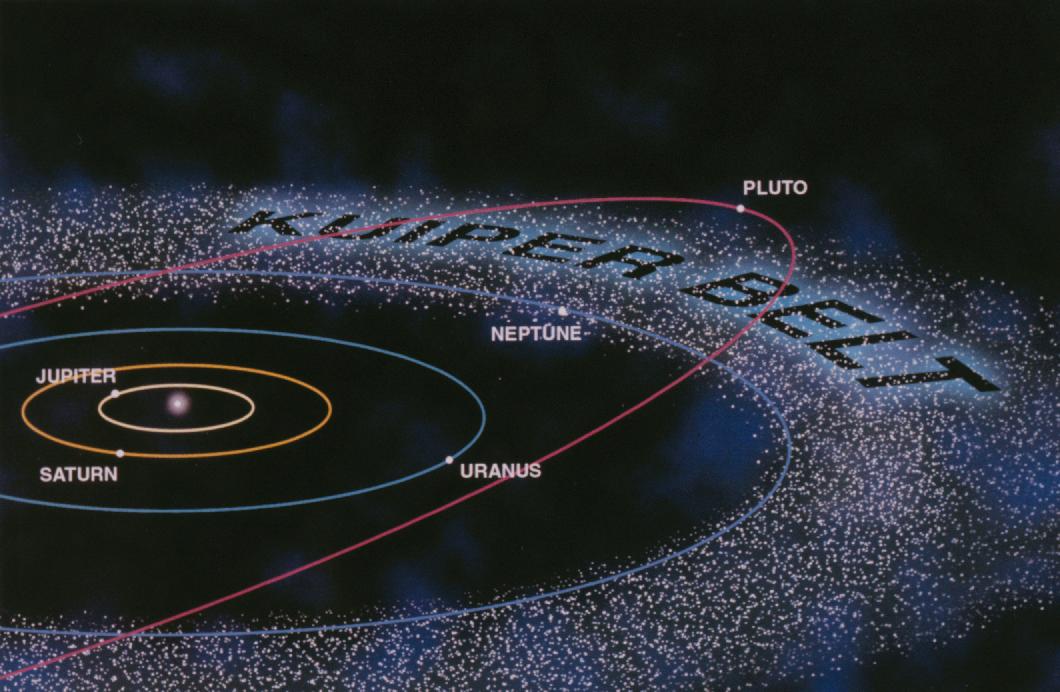 |
The kuiper belt was first known of in 1992. The first astonamer to hypothesies of a trans neptunian population (objects beyond neptunes orbit) was Fredric C. Leonard. Kenneth Edgeworth in 1943 guessed that beyond Neptune, material within the primordial solar nebula was to widely spread to come together to form planets. From this he concluded that the outer region , beyond the planets was occupied by a massive amount of similair small objects. In the 1980's one scientist named Gerald Kuiper predicted the existance of the kuiper belt objects, but he was making his assumptions in his time that pluto was the size of earth.
 | The kuiper belt is a complex structure and is still is unclear to many astronomers, but is clear that it is manly made up of Planetesimals, fragments from the original proto-planetary disc around the sun that failed to fully condense into planets. Since the kuiper belt is very cold the original gas and dust from the beginning of the solar system may still be frozen inside KBO's today. The Kuiper Belt is mostly made up of ices in
the mixture of light hydro carbons such as methane, ammonia and water
ice; the same compostion of most comets. Water Ice has been found on
several KBO's including 1996 TO66, 2000 EB173, 2000 WR 106. The
temperature of the belt is only 50 degrees kalvin making most gas
substances near the sun, to be solid near pluto. |
Modern computer simulations have shown that kuiper belt has been strongly influenced by the orbits of Jupiter and Neptune. They also suggest that Uranus or Neptune could have in situ beyond Saturn as not enough primordial mater existed that from the sun to produce objects of such high mass.
The Kuiper Belt is roughly 30 - 55 AU from the sun. The main part of the belt consists of a orbital resonance of 2:3, 3: 5, and 4:7 meaning that the objects will orbit so many times in the time that Neptune orbits. The presense of Neptune has a big effect on the Kuiper Belt's structure due to the orbital resonance. The 2:3 resonances are called the Plutinos. |  |
